

Iceland Adventure: Geography Students Explore the Land of Fire and Ice
11th June 2026
Recently, a group of 27 Geography students from Year 9, Year 10, Year 11 and Lower Sixth Form embarked on an unforgettable educational adventure to Iceland. Over four action-packed days, pupils experienced some of the world’s most dramatic landscapes, explored fascinating geological features, and created memories that will last a lifetime.
Read on to discover why Iceland was the perfect place to support our Geography pupils’ learning and what they got up to!
“Iceland was chosen as our destination because it truly is the land of fire and ice, offering students a rare opportunity to see Geography in action. In Year 9 and as part of the AQA GCSE specification, we study tectonics, and this trip brings those concepts to life in an unforgettable way. From standing between tectonic plates at Thingvellir National Park and ‘The Bridge Between Continents’ on the Reykjanes Peninsula, to witnessing geothermal activity at Geysir, Gunnuhver and Krysuvik, students experience first-hand the dynamic processes shaping our planet.
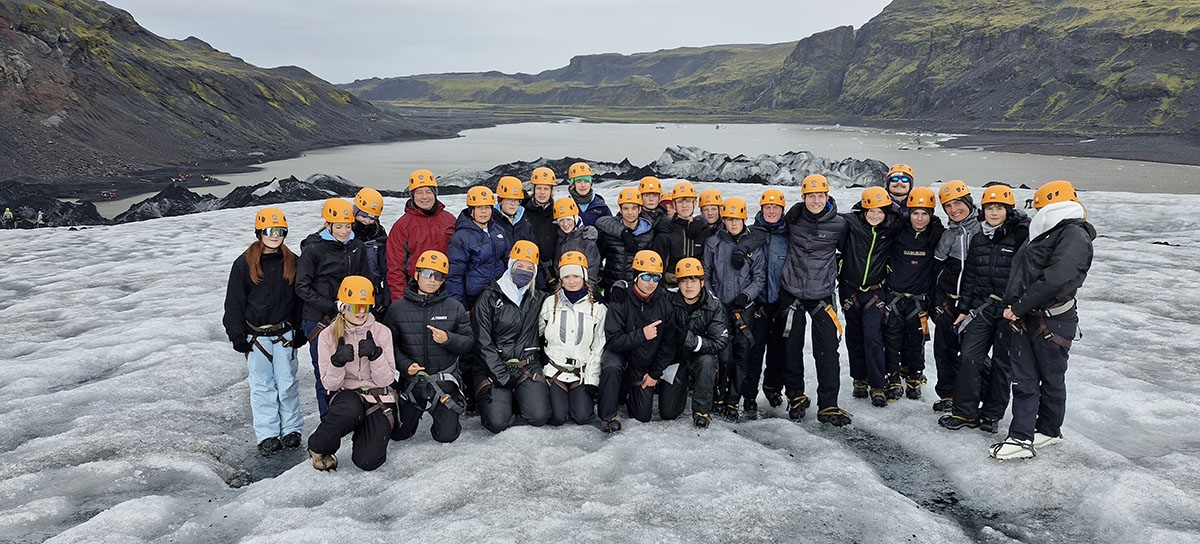
Visiting dramatic landscapes such as Gullfoss, Seljalandsfoss and Skogafoss waterfalls, the black sands of Reynisfjara, and hiking on Solheimajökull glacier allows them to appreciate both volcanic and glacial features in one place. This immersive experience helps students understand how people live with and adapt to hazards, while reinforcing and enriching their classroom learning in a powerful and memorable way.”
Ms Lambert, Head of Geography
Day One: Walking Between Continents
The trip began with an extraordinary introduction to Iceland’s unique geology. Students crossed the famous Bridge Between Continents, where they stood directly on the boundary between the North American and Eurasian tectonic plates. It was a fantastic opportunity to witness first-hand the geological processes they have studied in the classroom.
The group then explored a lava field formed just three years ago, where the ground was still warm in places from Iceland’s recent volcanic activity. The day concluded at the steaming Gunnuhver hot springs, an otherworldly geothermal area steeped in local folklore and said to be haunted by the ghost of Guðrún. The combination of science, history and mythology made for a memorable start to the trip.


Day Two: Geothermal Wonders and Natural Beauty
Friday saw students heading out from Reykjavík Harbour in search of Iceland’s famous marine wildlife. Although the whales proved elusive on this occasion, pupils were delighted to spot playful dolphins and puffins, providing plenty of excitement on the open sea.
The afternoon was spent exploring some of Iceland’s most famous natural attractions. At Geysir, students watched in amazement as Strokkur erupted, sending boiling water high into the air every few minutes. The group then visited the breathtaking Gullfoss waterfall, where powerful glacial waters thunder through a dramatic canyon.
After a busy day of exploration, everyone enjoyed a well-earned opportunity to relax in the naturally heated waters of the Secret Lagoon, one of Iceland’s oldest geothermal bathing spots.


Day Three: Glaciers, Waterfalls and Adventure
Saturday was undoubtedly one of the most exciting days of the trip. Setting off from Reykjavík at dawn, students travelled to Sólheimajökull glacier, where they spent the morning glacier trekking across the stunning ice formations. For many, this was a genuine once-in-a-lifetime experience and a chance to witness the effects of glaciation up close.
The adventure continued with visits to two of Iceland’s most iconic waterfalls. Students climbed to the top of Skógafoss to enjoy spectacular views across the surrounding landscape before experiencing the unique opportunity to walk behind the cascading waters of Seljalandsfoss.
Following a day of exploration and adventure, the group enjoyed a relaxing swim at Laugardalslaug before returning to the city for some well-deserved pizza.


The Final Day of the Trip
As the trip drew to a close, students enjoyed some time in Reykjavík, the world’s northernmost capital city, with opportunities for last-minute souvenir shopping before their journey home.
A particular highlight of the final day was visiting Thingvellir National Park, a UNESCO World Heritage Site situated within a vast rift valley on the Mid-Atlantic Ridge. Here, students walked between dramatic fissures and gained a deeper understanding of the tectonic forces that continue to shape Iceland’s remarkable landscape.
Learning Beyond the Classroom
The Iceland Geography trip provided students with an exceptional opportunity to bring their classroom learning to life. From tectonic plate boundaries and volcanic landscapes to glaciers, waterfalls and geothermal activity, pupils experienced some of the most significant geographical features on Earth first-hand.
We would like to thank all the staff who organised and accompanied this fantastic trip, and congratulate our students for representing the school so positively throughout the visit. Their enthusiasm, curiosity and exemplary behaviour made the experience a success for everyone involved.
Start their journey…
More News


Design by Desire Path Agency Built by Netmatters
© Copyright Langley School 2026. All rights reserved.