


Langley Senior School delivers top-level progress at GCSE and A Level
19th February 2026
One of the key metrics for successful educational institutions is that of progress. Whilst GCSE and A Level grades reflect absolute performance, what is often hidden from view is the progress made by individual pupils and schools. This is a critical measure for us, as we work hard to ensure access to the A Level curriculum for as many students as possible, versus many other schools where availability of subjects is restricted to top-performing students. At Langley, we recognise that development and resultant progress can occur at any stage in the educational journey and we are there to encourage our students every step of the way.
2025 ALPS results for Langley Senior School
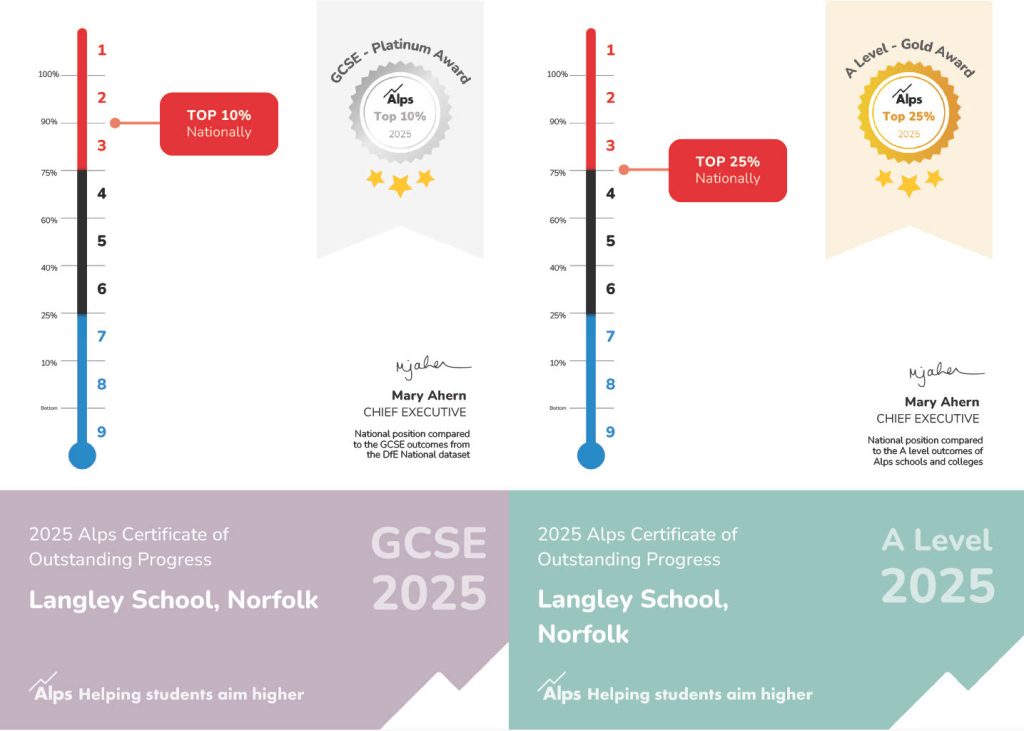
Langley delivered a performance in the top 10% of UK and UK curriculum-following international schools in the 2024-2025 academic year, reflecting performance in May/June 2025 GCSE examinations. The corresponding score for A Level performance placed us in the top 25% of schools. This means that our students make progress in the top decile and top quartile respectively; a true reflection of the quality of teaching our pupils receive from our academic staff.
Understanding ALPS
You may have heard the term “value-added” before in relation to educational attainment. The ALPS dataset delivers an objective measure of performance at individual student and school level. It is used widely by schools in the state and independent sector, as well as international schools that follow the British curriculum.
The ALPS dataset contains baseline data from student assessment tools such as CEM data, CATs and GCSEs. ALPS is highly respected within the educational community, providing a marker of performance that allows schools to measure the quality of intervention, teaching and support provided to students over time.
GCSE ALPS scores are based on prior attainment data drawn from datasets such as CEM, while A Level ALPS scores are based on progress from GCSE to A Level, based on pupils with equivalent results at GCSE.
The grading tool produces an output akin to a thermometer (insert visual images), making it visually clear how students and schools are performing. The overall score is based on 9 sections which, combined together, represent a benchmark of national performance.
Essentially, what our scores reflect is that our GCSE pupils, when compared with students with the same baseline attainment data, produce results better than those of 90% of other schools. At A Level, our pupils when compared with others with equivalent GCSE results, produce outcomes better than those of 75% of other schools.
Why are Langley’s GCSE and A Level outcomes different?
As the measures reflect progress, there is a smaller relative opportunity for progress between GCSE and A Level than pre A Level. This is because once the leap from school entry to GCSE outcomes has been made, additional progress is made in smaller increments.
Our commitment
At Langley, our commitment to each child is that we will support them to achieve their potential, regardless of their start point. There is so much more about everyone’s educational story than their final exam results, and at Langley we commit to working in partnership with families to help children progress, whether that is to follow a career in medicine or music, to excel on the sports field or to pursue a career in business.
For more information on ALPS, please visit www.alpseducation.com



Design by Desire Path Agency Built by Netmatters
© Copyright Langley School 2026. All rights reserved.


